Evolutionary Mismatch
Let me introduce to you a concept called “Evolutionary Mismatch”, which is an idea that our bodies are still being programmed for an environment that no longer exists.
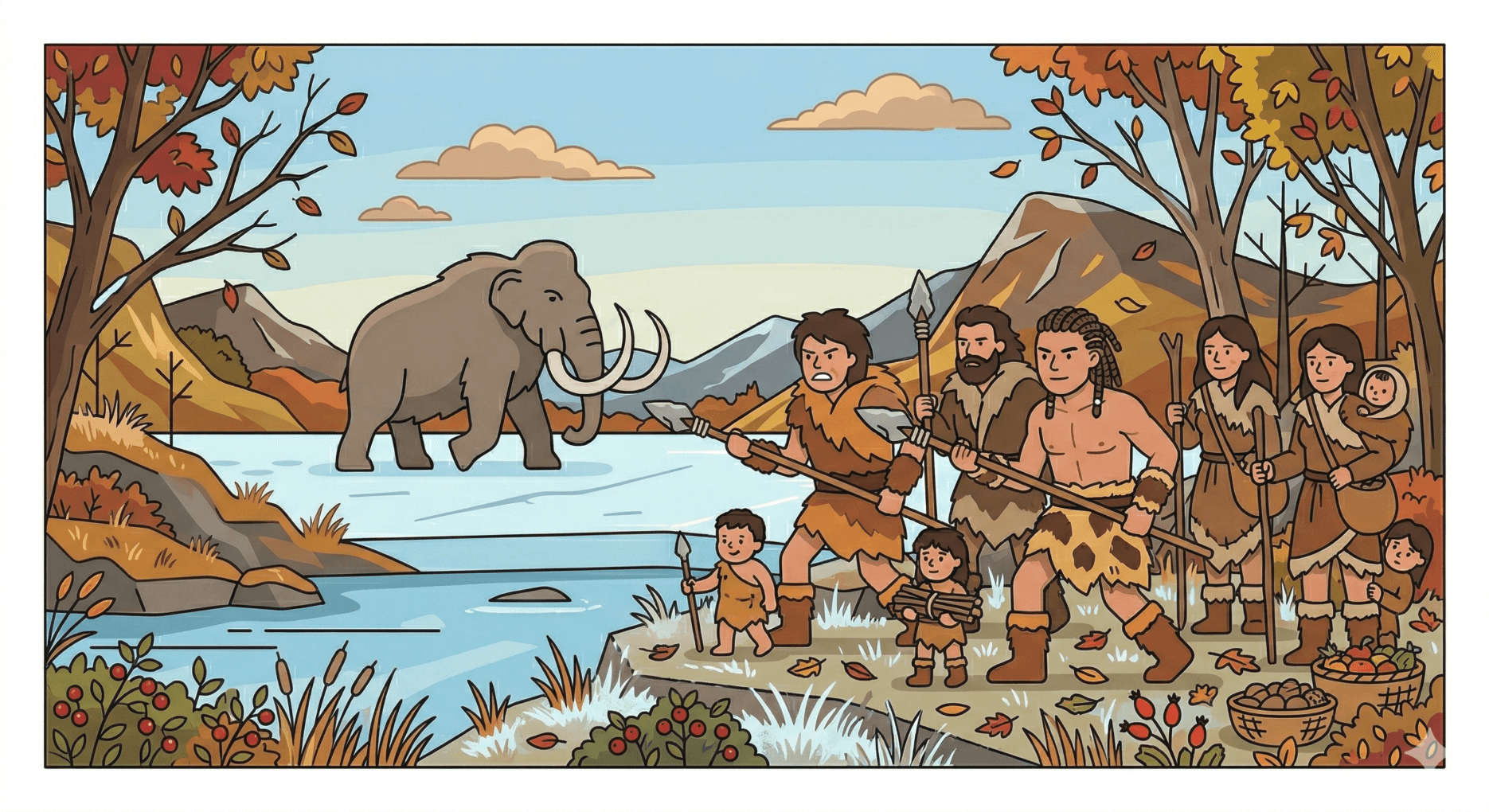
Imagine you are a Prehistoric human. You need to hunt for food, or you need to gather fruits and berries for your family. You had many dangerous encounters in the wild. Some of your friends did not make it past the age of 15.
You would think that these ageing diseases barely occurred because prehistoric humans lived in a brutal environment.
Prehistoric humans can live long
The old way of thinking is that these ageing diseases barely existed in Prehistoric humans due to the high mortality rate. The life expectancy was only 30 – 40 years old, but a new study (Gurven et al 2024) suggested that the life expectancy is skewed by the infant and juvenile (age 15 or less) mortality. The twist is, if you manage to survive childhood, it is possible to live up to your 70s! After conducting research on the fossil records, especially those of older individuals, Gurven found out that humans can live up to 70s – 80s. Furthermore, it was surprisingly rare to find neurodegenerative disorders in these fossil records. Just keep in mind that living up to the 70s-80s was not the norm in those days, but definitely doable.
Environment is a major influence on our lifespan and healthspan
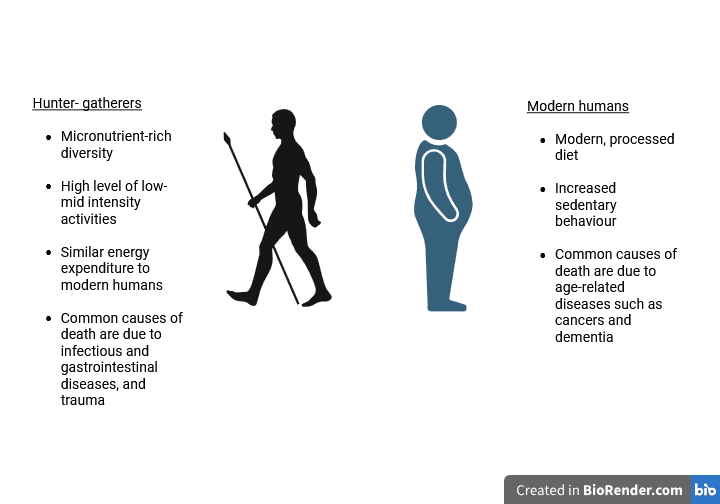
Oppositely, in the modern days, it is common for people to age into their 70s to 80s and, sometimes, they can even live up to the 90s, thanks to advancement in healthcare. However, unlike in prehistoric times, ageing diseases are wide-spread in modern times. So what are some factors that give rise to these diseases? Our bodies are not adapted to live in the modern environment, hence it is an evolution mismatch. Figure 1 illustrates the difference between the lifestyles of hunter-gatherers and modern humans.
Our bodies are made to walk long distances, which is one of the primary reasons that we are able to travel to far away places. Unlike other mammals, Homo sapiens is the only species that travels on two legs. Our muscles, heat regulation and bipedal movement are perfect for long distance walking. While we are not the fastest nor strongest, we can cover huge distances to forage food, water and shelter.
The modern environment greatly reduces the need to walk, and other physical activities such as gathering food and farming are mostly, if not completely, phased out. Additionally, the modern environment has brought us an unprecedented amount of artificial pollutants that do not exist in the prehistoric environment. Factories and vehicles producing air and noise pollution, poor diets, excess unwarranted stress, poor sleep have led us to be more susceptible to ageing diseases (Figure 2).
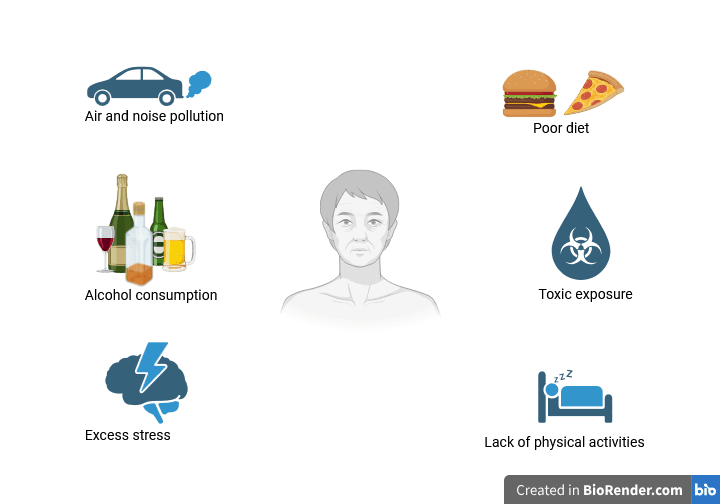
We have built a world that is constantly changing, and our bodies simply cannot adapt to the pace. What will happen to us when we continue to live in this mismatched world? Although advanced medical treatments allow us to live longer, we are also getting sicker. Why is this? Are ageing diseases an evolutionary mistake? Not necessarily; it is more of a misalignment between our bodies and the environment, but the misalignment has brought contradictions.
In this article, we discussed how the modern environment had resulted in an increased number of ageing disease cases. In the next one, we will talk about how the modern environment has led to the “Longevity Paradox”, which is a continuation of this article. See you next time.
Sources:
1. Gurven MD. Lifespan and Mortality in Hunter-Gatherer and Other Subsistence Populations. In: Lemaître J-F, Pavard S, eds. The Biodemography of Ageing and Longevity. Cambridge University Press; 2024:217-238.
2. Pontzer, H., Wood, B.M. and Raichlen, D.A. (2018). Hunter-gatherers as models in public health. Obesity Reviews, 19(1), pp.24–35. doi:https://doi.org/10.1111/obr.12785.
The Disclaimer: This article is for informational and educational purposes only and does not constitute medical advice. Always consult with a healthcare professional regarding any medical concerns or before making changes to your health regimen.
Attributions & Ownership * Text & Data Visualization: All written content and scientific diagrams (Figure 1 and Figure 2) were authored and designed by the creator of this series.
- Illustrations: The introductory cover illustration was generated with the assistance of Gemini AI.